


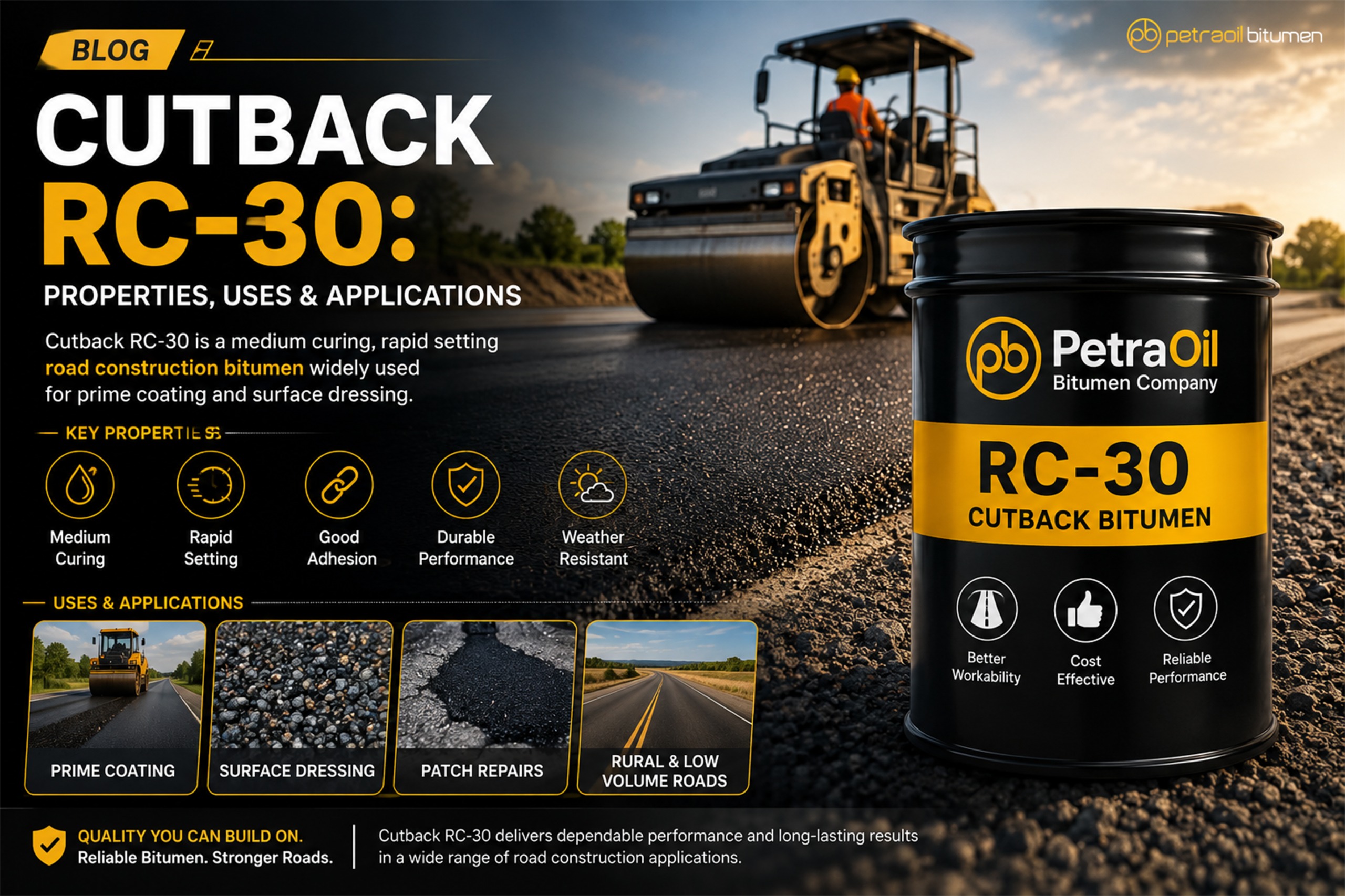
Road construction projects often require a binder that can be applied efficiently without the high temperatures normally needed for conventional paving bitumen. This is where Cutback RC-30 can be considered for specific pavement and maintenance applications. As a rapid curing cutback bitumen, RC-30 combines bitumen with a volatile petroleum based diluent to reduce viscosity and increase workability during application.
It is crucial for contractors, engineers, and procurement teams to understand how RC-30 acts, where it is appropriate, and what quality characteristics need to be evaluated before specifying or purchasing the material. This guide reviews Cutback RC-30 bitumen, its qualities, its applications, quality considerations, and practical factors in procurement for infrastructure projects in foreign markets.
What Is Cutback RC-30?
RC-30 cutback bitumen is a rapid curing grade of cutback bitumen produced by reducing the viscosity of bitumen with a suitable petroleum diluent. The lower viscosity allows it to flow and coat aggregate or prepared surfaces more readily during application.
The “RC” designation refers to rapid curing, while “30” represents the grade’s specified kinematic viscosity range. Under commonly referenced specifications, RC-30 has a kinematic viscosity of 30–60 mm²/s (cSt) at 60°C, tested according to ASTM D2170.
How Does Rapid Curing Cutback Bitumen Work?
The solvent or cutter temporarily lowers the viscosity of the base bitumen. After application, the more volatile components gradually evaporate, allowing the remaining bituminous binder to develop its intended characteristics.
This curing mechanism is the key distinction between cutback bitumen and conventional paving grades. However, curing behaviour can vary with temperature, weather, surface conditions and application practices, so project specific requirements should always be considered.
Typical Properties of RC-30
Commonly referenced RC-30 specifications include:
- Kinematic viscosity at 60°C: 30–60 cSt
- Distillate to 225°C: minimum 55% by volume
- Distillate to 260°C: minimum 75% by volume
- Distillate to 316°C: minimum 90% by volume
- Residue from distillation to 360°C: minimum 50% by volume
- Penetration of residue at 25°C: 80–120
- Ductility at 25°C: minimum 100 cm
- Water: maximum 0.2% by volume
These values are commonly associated with ASTM-based RC-30 specifications, but the applicable project specification should always take precedence.
Applications of RC-30 Cutback Bitumen
The relatively low viscosity of rapid curing cutback RC-30 makes it suitable for selected road construction and maintenance applications where penetration, coating and workability are important.
Prime Coat Applications
One of the established uses of RC-30 is as a prime coat on suitable granular or stabilized pavement bases. The material can penetrate and bind the surface of the prepared base while providing a bituminous interface for subsequent pavement layers.
The suitability of RC-30 as a prime coat depends on the base material, surface condition, pavement design and project specification. Some technical product data sheets specifically identify RC-30 for priming cement or lime stabilized bases and certain aggregate or soil bases.
Pavement Surface Treatment
RC-30 may also be used in selected surface treatment and maintenance operations where a lower-viscosity binder is required to coat aggregate effectively.
Its application should be controlled carefully because the rate of curing and the final binder condition depend on environmental and surface conditions. Proper application rates and aggregate compatibility are therefore important for achieving consistent results.
Patching and Maintenance Work
Rapid curing cutback bitumen can also be used in certain patching or cold-mix applications. The reduced viscosity makes mixing and placement easier in applications where heating conventional bitumen may not be practical.
The exact formulation and aggregate requirements should be established according to the project specification rather than assuming that every RC-30 product is suitable for every cold mix application.
Key Considerations When Selecting RC-30 Bitumen
Selecting RC-30 bitumen should involve more than checking the product grade. Contractors and procurement teams should assess technical compliance, site conditions, handling requirements and supply reliability together.
Check the Technical Specification
Before placing an order, buyers should request a current technical data sheet and certificate of analysis or test certificate for the relevant batch. Important parameters include:
- Kinematic viscosity
- Distillation characteristics
- Residue properties
- Penetration
- Ductility
- Water content
- Solubility
- Applicable test methods
The specification stated in the purchase contract should match the standard required for the project and destination market.
Consider Site and Climate Conditions
Temperature, humidity, rainfall and surface condition can influence the behaviour and curing of cutback materials. Projects in tropical, coastal or high temperature regions may therefore require particular attention to application timing, storage and curing conditions.
For international procurement across regions such as Africa, Asia, the Pacific and Caribbean markets, buyers should also verify local requirements concerning the use, transportation and storage of solvent containing bituminous products.
Evaluate Handling and Storage Requirements
Because cutback bitumen contains volatile components, safe handling is an important consideration. Appropriate PPE, ventilation, ignition source control and storage practices should be followed in accordance with the product’s safety documentation.
PetraOil’s RC-30 product information also recommends appropriate protective equipment and storage in a cool, well-ventilated location.
Verify Packaging and Logistics
For export projects, packaging can have a direct impact on product integrity and handling efficiency. Depending on project requirements and supplier capability, RC-30 may be supplied in drums, IBC containers or bulk formats.
Procurement teams should confirm the net weight, packaging specification, loading arrangements, shipping requirements and documentation before finalising an international order.
Quality Control and Procurement Best Practices
A reliable supply of Cutback RC-30 bitumen depends on both product quality and supplier controls. Buyers should consider the following before procurement:
- Specification compliance: Confirm that the material meets the required standard and project specification.
- Batch testing: Request relevant test results for the supplied batch rather than relying only on generic product data.
- Traceability: Ensure that batches can be identified through production and shipping documentation.
- Packaging integrity: Inspect drums or containers for leakage, damage and contamination.
- Safety documentation: Obtain the applicable SDS and handling instructions before shipment.
- Storage conditions: Confirm that the receiving facility can store the material safely and appropriately.
- Regulatory requirements: Verify whether the use, transport or import of solvent-containing cutback bitumen is subject to restrictions in the destination market.
Environmental and regulatory requirements are particularly important when specifying cutback products because they contain volatile petroleum-based components. The suitability of RC-30 should therefore be assessed against the current requirements of the project location rather than selected solely based on performance or price.
Conclusion
Cutback RC-30 remains a specialised bituminous material for applications where reduced viscosity and rapid curing characteristics are required. Its established uses include selected prime coat, surface treatment and maintenance applications, subject to project specifications and local requirements.
For contractors, engineers and procurement professionals, the right approach is to evaluate viscosity, distillation characteristics, residue properties, handling requirements, site conditions and regulatory considerations together. A supplier should also be able to provide appropriate technical documentation and batch-level quality information.
For projects requiring RC-30 cutback bitumen, careful specification and quality verification can help ensure that the selected material is appropriate for the intended application and delivery conditions. Contact PetraOil Bitumen to discuss product specifications, packaging, documentation and supply requirements for your project.
