


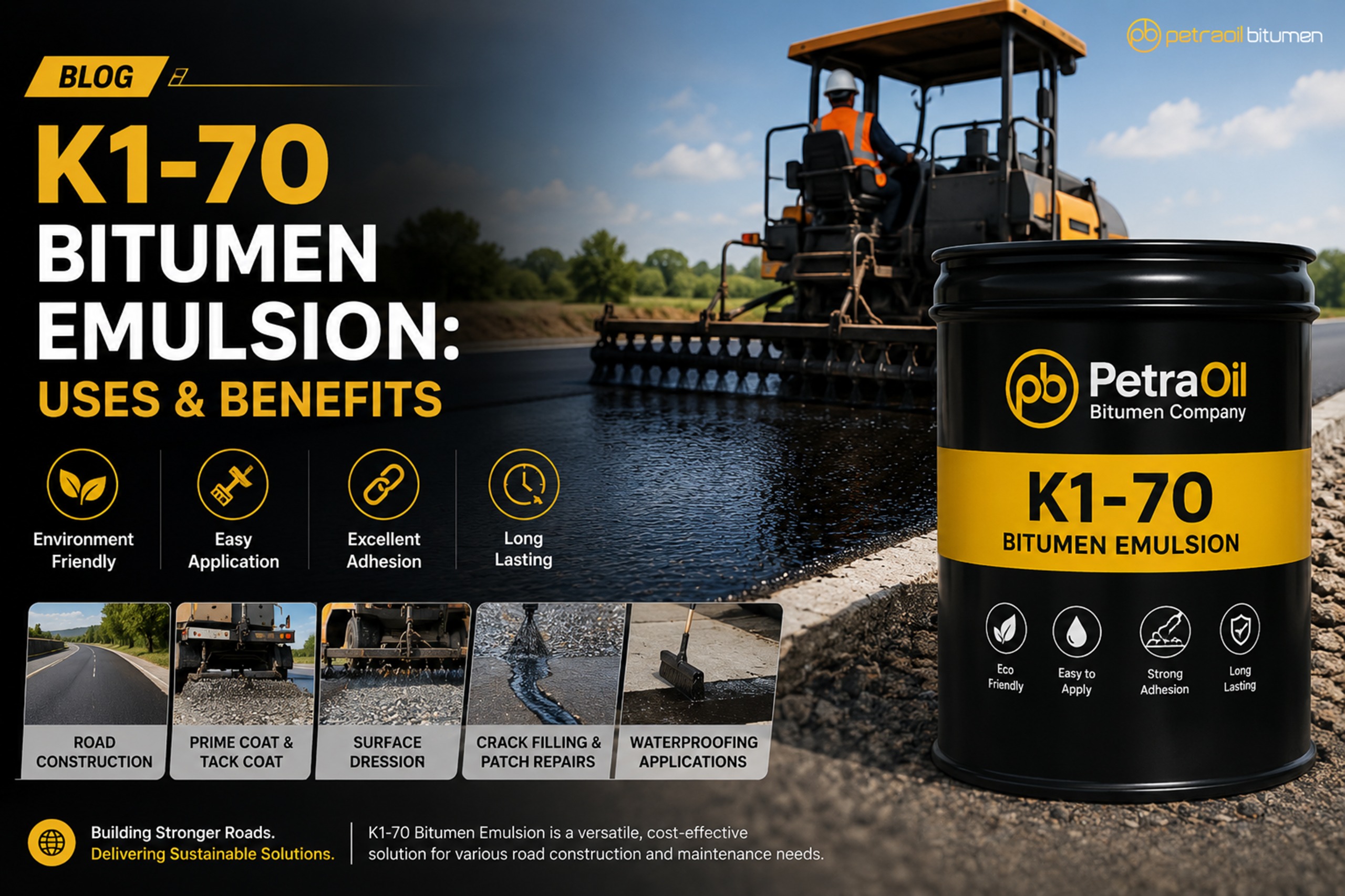
Road construction projects often need materials that provide reliable adhesion, efficient application and consistent performance under demanding site conditions. For contractors and infrastructure teams, the choice of binder can directly influence the quality and durability of surface treatments, overlays and maintenance work.
K1-70 bitumen emulsion is a cationic, rapid setting bitumen emulsion designed for applications where effective bonding and controlled breaking of the emulsion are important. Unlike conventional heated bitumen, an emulsion disperses bitumen in water with the help of an emulsifying agent, allowing it to be handled and applied in liquid form. K1-70 is commonly associated with tack coating, surface treatments and road maintenance applications.
What Is K1-70 Bitumen Emulsion?
K1-70 is a cationic rapid setting bitumen emulsion in which bitumen is dispersed in water using an emulsifying agent. The “cationic” classification refers to the positive electrical charge of the dispersed bitumen particles. With a positive particle charge and a binder content range of 70–75%.
The emulsion remains fluid during application and then breaks as the water separates from the bitumen. This allows the residual binder to form a continuous film and develop adhesion with the underlying surface or aggregate.
Why the K1-70 Grade Matters
The grade is particularly relevant where rapid setting and effective bonding are required. K1-70 is commonly used for tack coats and surface treatments, while its cationic characteristics can support adhesion to aggregate surfaces under practical roadwork conditions.
However, the correct grade should always be selected according to the project specification, aggregate characteristics, climate, application method and applicable local standards. Product classifications and test requirements can vary between markets, so buyers should confirm the technical data sheet before placing an order.
Applications and Benefits of K1-70 Emulsion in Road Construction
K1-70 emulsion is primarily useful in road construction and maintenance operations where controlled application of a bituminous binder is required.
Tack Coating
One of the principal applications of bitumen emulsion K1-70 is tack coating. A tack coat creates adhesion between an existing pavement layer and a new asphalt layer, helping the pavement layers act together rather than behaving as separate surfaces.
For contractors, consistent spraying and appropriate application rates are important. Excessive application can create problems, while insufficient coverage may reduce bonding performance.
Surface Dressing and Surface Treatments
K1-70 can also be used in surface treatment applications where a bituminous binder is sprayed onto a prepared road surface and combined with aggregate. These treatments can support pavement maintenance and surface protection when designed and executed according to project requirements.
Patching and Road Maintenance
Road maintenance frequently involves localized repairs where efficient material handling is important. Cationic emulsion grade K1-70 can be considered for suitable patching and maintenance applications, subject to the project specification and compatibility with the materials being used.
Key Benefits
For suitable applications, K1-70 offers several practical advantages:
- Rapid setting: The emulsion is designed to break relatively quickly after application.
- Effective adhesion: Its cationic formulation supports bonding with appropriate aggregate and pavement surfaces.
- Liquid application: The water based form allows the binder to be applied without handling conventional hot bitumen in the same way.
- Application flexibility: It can be used across several road maintenance and surface treatment operations.
- High binder content: With a 70–75% binder content.
The actual performance achieved on site depends on formulation, surface preparation, weather, application equipment, aggregate characteristics and workmanship.
What Should Buyers Consider When Sourcing K1-70 Bitumen?
Selecting a supplier involves more than comparing the quoted price per tonne. Procurement teams should evaluate technical compliance, consistency, packaging, logistics and documentation together.
Check the Technical Specification
Before purchasing K1-70 bitumen, buyers should review the supplier’s current Technical Data Sheet (TDS). Important parameters can include:
- Binder content
- Particle charge
- Viscosity
- Sieve residue
- Storage stability
- Applicable test methods
- Relevant conformity or compliance requirements
Generally, K1-70 specification identifies positive particle charge, ASTM test methods and a 70–75% binder-content range. Because specifications can differ by formulation and market, the supplier’s current TDS and Certificate of Analysis should take precedence over generic online specifications.
Consider Storage and Handling
Bitumen emulsions require appropriate storage and handling to maintain product consistency. Buyers should confirm recommended storage conditions, shelf life information, temperature limitations and container requirements with the supplier before delivery.
Avoiding contamination and unsuitable temperature exposure is particularly important. Site teams should also follow the supplier’s Safety Data Sheet and handling instructions.
Evaluate Logistics and Packaging
For international procurement, packaging and logistics can have a significant impact on the delivered cost and project schedule.
Depending on project volume and destination, buyers may need to evaluate drums, intermediate bulk containers or bulk transportation. The most suitable option depends on consumption rate, storage infrastructure, transportation distance and local handling capabilities.
Procurement teams should also confirm:
- Production and dispatch lead time.
- Port and delivery terms.
- Available packaging formats.
- Inspection and quality documentation.
- Batch consistency and traceability.
- Destination/country import and product requirements.
A technically suitable product is only useful if it reaches the project site in the required condition and timeframe.
Match the Product to the Project
The best procurement decision is not necessarily the lowest cost emulsion. Contractors should first establish the required application, spray equipment, aggregate type, climatic conditions, traffic requirements and project specification.
For international projects, it is also important to confirm whether the supplied K1-70 formulation meets the standard or specification referenced in the tender or contract documents.
Conclusion
K1-70 bitumen emulsion is a practical binder for road construction and maintenance applications where rapid setting, adhesion and controlled application are important. Its principal uses include tack coating, surface treatments and suitable patching and maintenance operations.
For contractors, engineers and procurement teams, successful use depends on more than simply selecting the K1-70 grade. Product specifications, application requirements, storage, handling, quality documentation and logistics should all be evaluated before procurement.
Contact our team at PetraOil Bitumen to discuss your technical requirements, packaging, documentation and international supply needs.
