


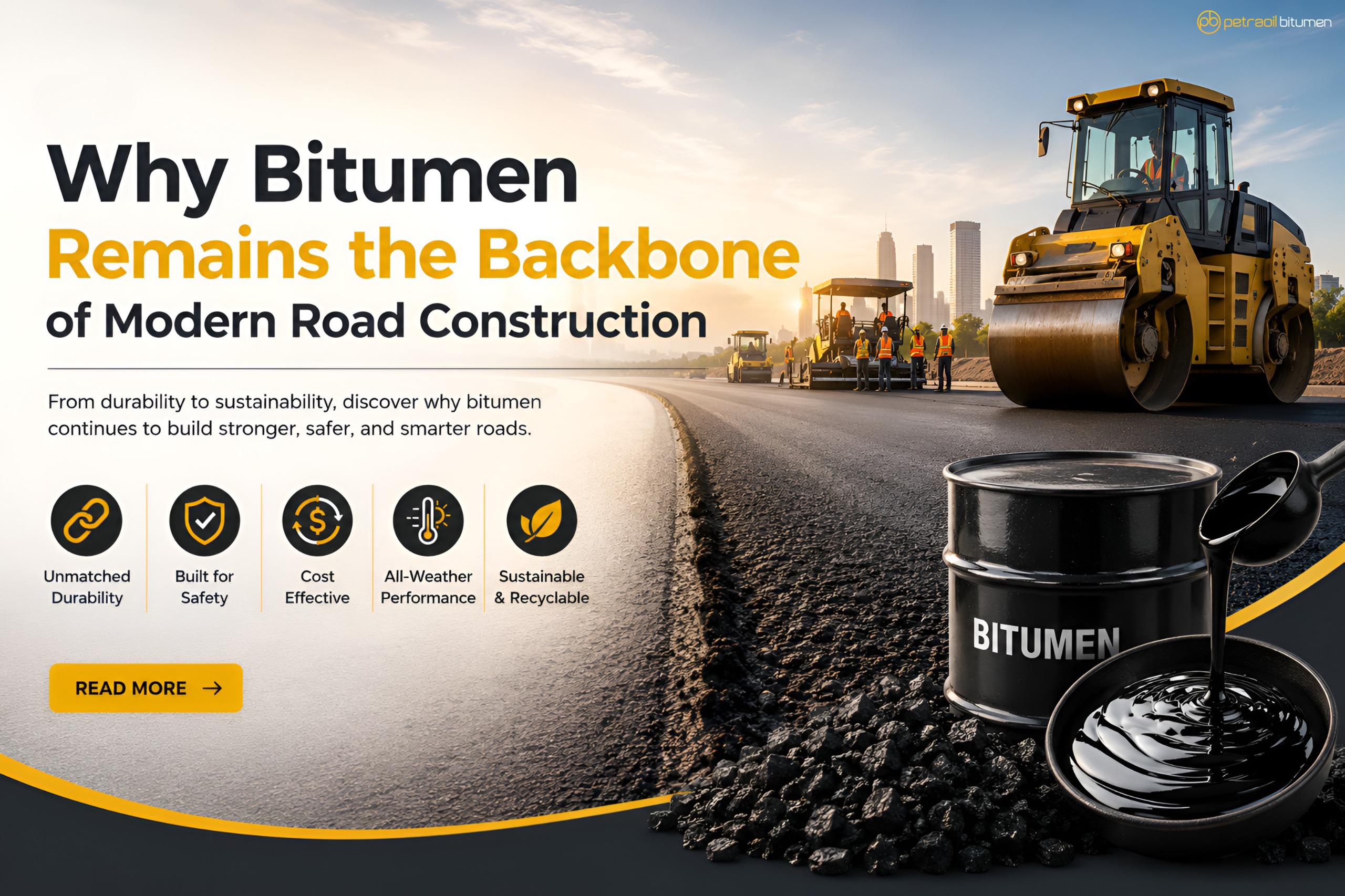
Morden roads are a vital part of the economic infrastructure, they boost growth by reducing transit times, removing logistic costs and connecting rural areas to urban spaces. Furthermore, they ensure safety through advance engineering and access during all weather conditions for essential services like healthcare and education.
For centuries bitumen has remained the preferred choice because of its strength, flexibility, cost effectiveness, and resistance to water and rut. As transportation networks continue to expand, engineers and contractors rely on this highly viscous petroleum based product to deliver longlasting pavements that meet modern performance standards. Since bitumen can be tailored to the need of the project based on their penetration and viscosity, bitumen like the bitumen 50/70, bitumen 60/70 and bitumen 80/100 can be chosen in accordance with the conditions in mind.
Why bitumen continues to dominate modern road construction:
Bitumen is a viscous and flexible material that keeps developing with modern advancements in its refinement. It is the most preferred material that contractors choose when it comes to paving roads because of its various adaptable properties like its versatility and its sustainability and its resistance to wear and tear making it an attractive option over its other counterparts. It is also an easy maintainable reuseable option which makes it favored.
Key benefits of using bitumen:
Bitumen has been the most preferred paving material for decades, with numerous advancements in through the years.
- Flexible and durable
It can withstand heavy traffic and slight ground vibrations without cracking unlike rigid pavements. - Cost efficient
Bitumen is less expensive than alternatives like concrete, making it ideal for larger road network construction. - Quick construction and repair
Roads made with bitumen can be laid and repaired relatively quickly, minimizing traffic disruptions. - Easy maintenance
Potholes and damaged sections can be repaired without having to replace the entire road, reducing long term maintenance costs. - Water resistance
It acts as a waterproof binder, helping protect the pavement structure from moisture damage. - Recyclable
Old asphalt pavement containing bitumen can be reclaimed and reused, making it a more sustainable choice - Skid resistance
When properly designed, bitumen pavements provide excellent grip, improving road safety. - Adaptability to different climatic temperatures
Modern bitumen formulations can be modified to perform well in both hot and cold environments, ensuring adaptability in various conditions.
Understanding different types of bitumen
Bitumen’s core types are classified by viscosity levels, penetration levels, and chemical modifications
Viscosity Grade (VG) Bitumen
Classified by flow characteristics at high temperatures like 60° C and 135° C. bitumen VG-10 is used for cold climates, while bitumen VG-30 and bitumen VG-40 are ideal for paving heavy duty highways in hot regions.
Penetration Grade Bitumen
Graded by the depth a standard needle penetrates the material at 25° C. Grades like bitumen 50/70 and bitumen 60/70 are used in warmer heavy traffic spaces and bitumen 80/100 is used for colder conditions.
Bitumen Emulsion
An eco-friendly mixture of bitumen dispersed in water. Perfect for cold mix paving and tack coats. It comes in Cationic and Anionic types.
Cutback Bitumen
Created by dissolving bitumen in solvents like kerosene or gasoline to lower its viscosity for cold weather patch repairs and surface priming.
Polymer Modified Bitumen (PMB) & Crumb Rubber (CRMB)
Blended with polymers or recycled rubber to improve elasticity and durability, making it ideal for high-stress areas like airport runways and heavily trafficked bridges and corridors.
Sustainability in Modern Road Construction
Sustainability has become a primary focus within the construction industry and the world in general, and bitumen continues to evolve alongside environmental goals.
Modern paving techniques increasingly incorporate reclaimed asphalt pavement (RAP), allowing existing bitumen and aggregates to be recycled into new road surfaces. This reduces material consumption, lowers waste generation, cuts down cost and minimizes environmental impact without compromising pavement quality.
Why Engineers Continue to Trust Bitumen
Despite ongoing advancements in construction materials, bitumen remains the industry’s most preferred pavement binder because it consistently delivers dependable performance. Its versatility and stability allows for it to be used in highways, airport runways, bridges, residential streets, parking lots, industrial facilities and for waterproofing buildings.
Combined with multiple penetration grades, like bitumen 50/70, bitumen 60/70, and bitumen 80/100; it provides engineers with solutions tailored to varying climates, traffic demands, and project requirements proving its adaptability.
Modern infrastructure depends on road networks that are durable, safe, and economical to install and maintain. Bitumen continues to meet these expectations through its exceptional flexibility, strong adhesion, waterproofing capabilities, and proven long term performance
Whether constructing major highways or local access roads, selecting the appropriate grade of bitumen helps ensure reliable pavement performance for years to come. At Petraoil you can select from the various penetration and viscosity graded bitumen tailored for your projects.
Get in touch with us for further assistance.
